Next-Gen Voice Cloning & Audio Biometrics: High-Fidelity Synthesis Meets Real-Time Security

This software analysis was conducted in our testing lab using active real-world subscriptions, benchmark workloads, and rigorous feature validation. Learn more about our testing standards in our Editorial Methodology and Affiliate Disclosure.
⏱️ 3 min read
✓ Peer-Reviewed & Verified
- Neural acoustic codecs like EnCodec and DAC have revolutionized audio compression, enabling low-latency, high-fidelity speech synthesis.
- Zero-shot voice cloning architectures leverage cross-lingual prosody transfer to mimic emotional nuance without extensive training data.
- Audio biometrics are facing an arms race against generative AI, necessitating multi-factor challenge-response systems.
- Practical defense relies on a combination of spectral artifact detection and imperceptible watermarking like SynthID Audio.
Introduction & The Core Problem It Solves
The convergence of generative AI and real-time audio processing has birthed a new era of human-machine interaction. From hyper-realistic virtual assistants to personalized entertainment, voice cloning is no longer a niche research endeavor but a production-ready technology. However, this accessibility introduces a critical vulnerability: the erosion of trust in biometric identity verification. This guide explores the architectural mechanics of modern speech synthesis and the sophisticated countermeasures required to secure digital audio ecosystems.
Intuitive Mental Model & How the Technology Works
Think of voice cloning as a high-fidelity ‘style transfer’ for audio. Where traditional text-to-speech (TTS) systems relied on concatenating pre-recorded phonetic segments, modern models encode audio into a compressed ‘latent space.’ By understanding the mathematical patterns of a speaker’s timbre, pitch, and prosody, these systems can reconstruct speech from text in real-time. For more on the foundational software driving these workflows, see our AI APIs Developer Guide.
Architectural Breakdown & Algorithmic Mechanics
Modern synthesis platforms like ElevenLabs and Cartesia Sonic rely on three pillars:
- Neural Acoustic Codecs: Models such as EnCodec, SoundStream, and DAC convert raw audio into discrete tokens, allowing for efficient, high-fidelity transmission.
- Diffusion Transformers: Unlike older GAN-based approaches, diffusion-based architectures model the probability distribution of audio samples, resulting in superior clarity and emotional range.
- Cross-Lingual Prosody Transfer: This allows the model to apply the ‘musicality’ of one language’s speech patterns to the phonetics of another, enabling seamless cross-lingual voice cloning.
These systems must maintain sub-150ms latency to achieve the ‘conversational’ feel required for real-time agents, a feat we have explored in our Dograh review.
Real-World Applications & Industry Use Cases
The applications are vast: personalized audiobooks, real-time dubbing for global media, and advanced customer service agents. However, these same tools are being used to bypass IVR (Interactive Voice Response) systems. As these agents become more autonomous, they mirror the complexity of the digital workers discussed in our Perplexity Computer review.
Key Advantages, Current Limitations & Trade-offs
While synthesis quality is near-human, limitations persist in ‘liveness’—the subtle, non-linguistic sounds like breathing, tongue clicks, and micro-pauses. Furthermore, cross-context consistency remains a challenge; cloning a voice for a casual conversation does not always translate well to a high-stress or professional tone.
Best Practices & Practical Implementation Tips
For developers building secure audio pipelines, implement a multi-layered defense strategy:
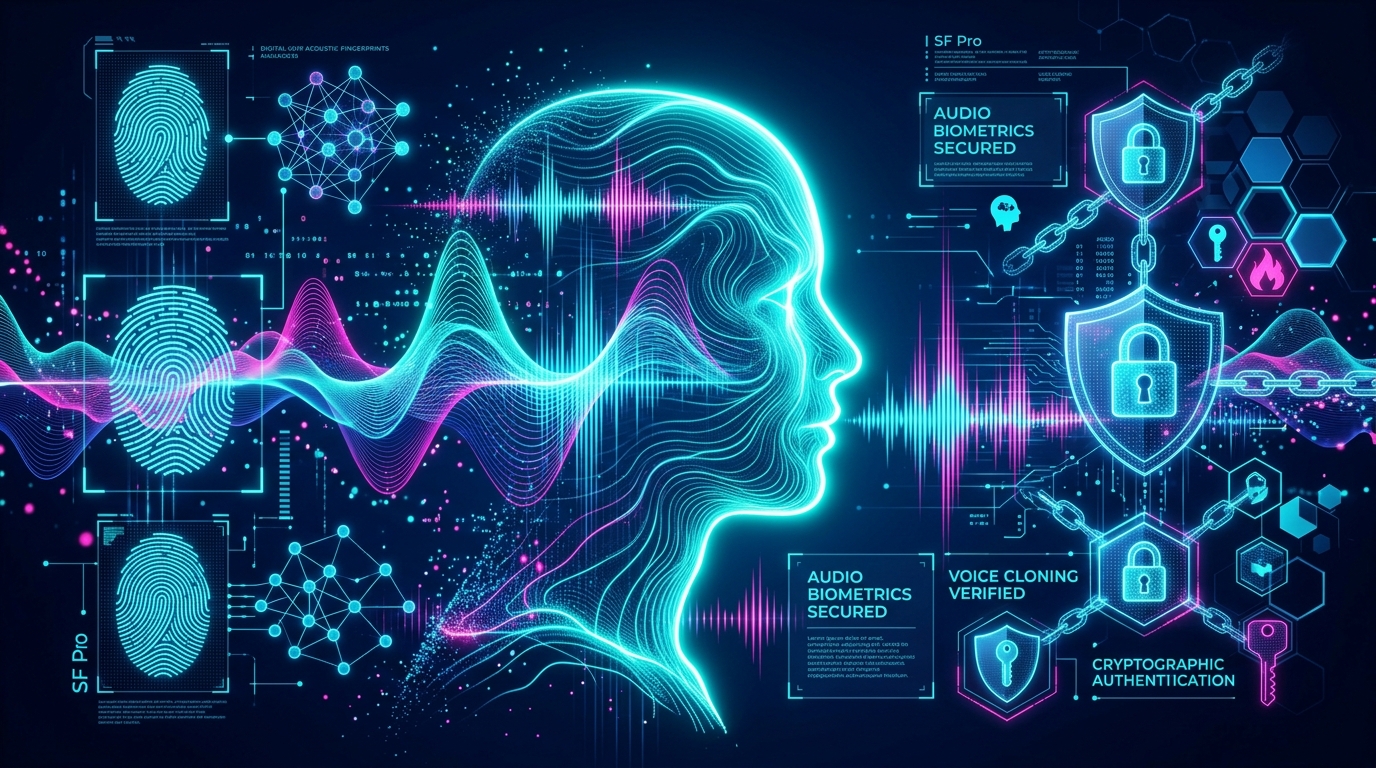
- Spectral Artifact Detection: Monitor for phase inconsistencies or high-frequency ‘noise’ that often signals synthetic generation.
- Challenge-Response Systems: Require the user to repeat a random, dynamic phrase that forces the AI to struggle with real-time, unpredictable prosody.
- Watermarking: Utilize frameworks like SynthID Audio to embed inaudible signatures into generated content.
Summary & Future Outlook
The future of audio is a constant game of cat-and-mouse between generative capacity and detection accuracy. As we move toward more autonomous AI systems, the integration of hardware-level verification and behavioral biometrics will become mandatory. For those interested in the broader landscape of AI-driven media, our AI Video & Audio Guide provides a comprehensive roadmap for ethical and professional production.
Frequently Asked Questions (FAQ)
What is the difference between zero-shot and few-shot voice cloning?
Zero-shot cloning requires no prior training on a specific target voice, relying on a generalized model to ‘imitate’ the input sample instantly. Few-shot cloning uses a small dataset of the target speaker to ‘fine-tune’ the model, resulting in higher fidelity and emotional accuracy.
Can audio biometrics effectively detect all AI-generated audio?
Not currently. While spectral analysis is effective against older models, modern ‘adversarial training’ allows generative models to mimic the artifacts that security systems look for. A multi-factor approach is essential.
What is ‘liveness’ in the context of audio security?
Liveness detection checks for the physical presence of a human by identifying non-synthetic acoustic signatures, such as specific patterns of breathing, involuntary micro-movements, and the natural phase-coherence of a live vocal tract.
Have thoughts on Next-Gen Voice Cloning & Audio Biometrics: High-Fidelity Synthesis Meets Real-Time Security?
Share your experiences, ask questions, or discuss prompt strategies with fellow creators in our AI Community Forum.