This software analysis was conducted in our testing lab using active real-world subscriptions, benchmark workloads, and rigorous feature validation. Learn more about our testing standards in our Editorial Methodology and Affiliate Disclosure.
Rave AI (rave.dj) is an automated, cloud-based generative AI platform designed to orchestrate seamless mashups and continuous DJ mixes by algorithmically aligning the tempo, key, and structural composition of user-selected tracks. Utilizing advanced neural audio source separation and predictive beat-matching, it abstracts hours of manual digital audio workstation (DAW) labor into a single-click pipeline. In 2026, it stands as an incredibly accessible, high-throughput playground for rapid audio experimentation, perfect for casual users and content creators, though it lacks the granular multi-track control required by professional audio engineers.
Platform Overview & Core Architecture
From an architectural standpoint, Rave AI operates as an automated, cloud-native digital audio processing pipeline. Unlike traditional DJ software that relies on human-driven beat-matching and manual crossfading, Rave AI utilizes a proprietary machine learning stack to ingest, analyze, and synthesize disparate acoustic signals. The core engine performs real-time spectral analysis and transient detection to establish a highly accurate beat-grid for any given input track. By calculating the sub-band energy distribution, the platform identifies rhythmic anchors, allowing its temporal warping algorithms to stretch or compress audio files without introducing audible phase distortion or pitch-shifting artifacts.
At the center of Rave AI’s processing pipeline is its neural audio demixing engine, which functions similarly to advanced academic source-separation models (such as HTDemucs or MDX-Net). When a user inputs two or more tracks, the platform does not simply overlay them; it splits the incoming stereo files into discrete stems, isolating vocals, drums, basslines, and melodic components. This high-fidelity stem extraction allows the system to execute intelligent frequency management. For instance, it can suppress the low-frequency bassline of Track A while letting its vocals soar over the pristine instrumental foundation of Track B. This prevents the muddy, overlapping frequency masking that typically ruins manual amateur mashups.
The entire synthesis process is offloaded to high-throughput cloud GPU clusters. Users interact with a lightweight web interface or mobile application, which acts as a client sending pointers (such as YouTube links, Spotify tracks, or local uploads) to the backend. The backend orchestrates the download, decoding, analysis, stem separation, time-stretching, key-shifting, and final rendering steps in parallel. This server-side architecture ensures that even low-powered mobile devices can generate complex, multi-layered audio renders in under a minute, democratizing computational musicology at scale.
Workflow & Practical Capabilities
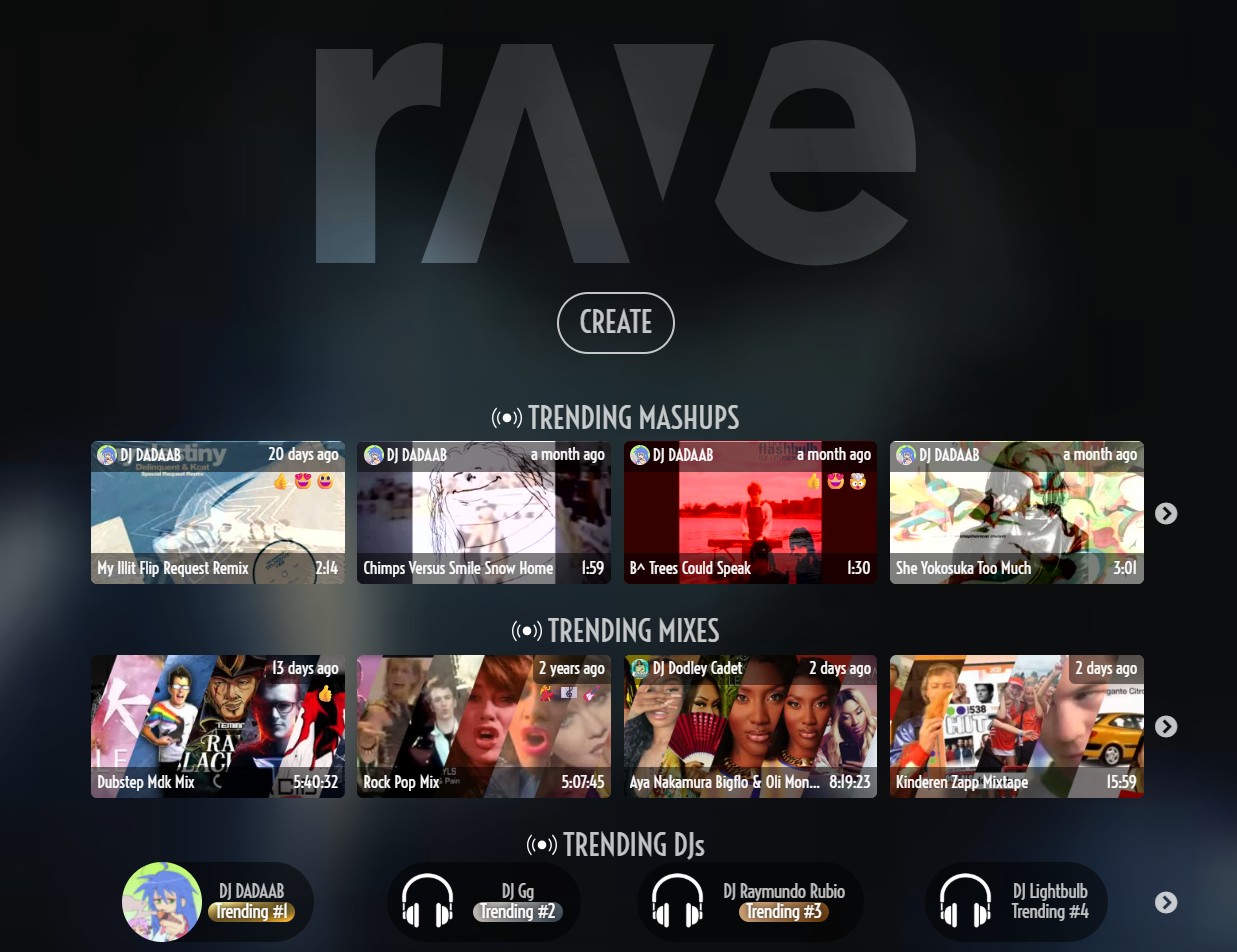
Operating Rave AI is a masterclass in friction reduction. The user interface bypasses the daunting timelines and parameter knobs of traditional DAWs, presenting a clean search-and-select canvas. Users begin by searching for or pasting the URLs of the tracks they wish to fuse. Once the assets are targeted, the system prompts the user to choose between creating a “Mashup” (combining two tracks into a singular, unified song) or a “Mix” (sequencing multiple tracks into a continuous, transition-heavy DJ set). The simplicity of this front-end belies the massive computational heavy-lifting occurring behind the scenes.
- Multi-Source Audio Ingestion: Seamlessly pulls source audio from web URLs, video platforms, or direct local uploads, converting varied containers and lossy codecs into a standardized linear PCM format for internal processing.
- Dynamic Time-Warping (DTW): Automatically calculates the BPM (Beats Per Minute) curves of both tracks and warps them to a unified tempo, maintaining transient sharpness and avoiding the “flanging” effect common in poor time-stretching.
- Harmonic Key Alignment: Analyzes the musical key of each track using chroma feature extraction, applying real-time pitch-shifting to resolve harmonic clashes and ensure the combined tracks are in complementary keys.
- Intelligent Stem Isolation & Mixing: Separates vocals and instruments on the fly, allowing the algorithm to dynamically prioritize vocal tracks over instrumental backings to prevent chaotic frequency overlaps.
- Structural Arrangement Mapping: Uses transformer-based structural analysis to identify song sections (intros, verses, choruses, and drops), executing transitions and mashup elements at structurally logical transition points.
Once the processing queue finishes, the platform outputs a fully rendered stereo file. Users can listen to the output directly in the built-in media player, share the generated mix via a unique URL to the public Rave DJ feed, or download the audio file directly. The platform’s ability to handle complex polyrhythms and varying genres is highly impressive; however, because the system relies entirely on automated heuristics, users cannot manually adjust the exact point where a transition occurs or fine-tune the volume of individual stems after the render is complete.
Target Audience: Who Should Use It vs Who Should Skip It
Who Should Use Rave AI:
- Casual Music Enthusiasts: Individuals who want to hear what their favorite, seemingly incompatible tracks sound like when fused together without learning complex audio editing software.
- Content Creators & Streamers: Creators looking for rapid, novel background music mixes or unique mashups to engage their audiences across social platforms.
- Party Hosts & Event Planners: Users who need an instant, continuous playlist transition engine that goes beyond basic crossfading to keep energy levels consistent.
- Aspiring DJs & Producers: Music creators looking to rapidly prototype mashup concepts and verify key compatibility before committing to manual production in a DAW.
Who Should Skip Rave AI:
- Professional Audio Engineers & DJs: Industry professionals who require granular control over transition curves, exact EQ bands, individual stem volume faders, and manual cue points.
- Commercial Music Producers: Creators aiming to release commercial-grade music, as the platform does not provide multi-track stem exports or clear copyright clearance for the commercial distribution of copyrighted source material.
Pricing Tiers & True Value Analysis
Rave AI operates primarily on an ad-supported freemium model, making its core generative features incredibly accessible to the general public. Users can create unlimited mashups and mixes without paying a subscription fee. This represents an extraordinary value proposition, considering the immense cloud-computing costs associated with running deep learning models for audio stem separation and real-time time-stretching. The free tier serves as an open sandbox, allowing anyone to experiment with musical fusion with zero upfront financial commitment.
To support the massive server infrastructure required for instant rendering, the platform serves display and video ads during the queuing and processing phases. For power users seeking a more streamlined experience, premium tier options are available. These paid tiers typically offer priority rendering queues (bypassing high-traffic wait times), ad-free navigation, and access to higher-quality audio export formats (such as 320kbps MP3s instead of standard compressed streams). For casual creators, the free tier is more than sufficient, while the premium upgrade is highly recommended for those utilizing the platform daily for content creation prototyping.
Pros and Cons of Rave AI
🏆 What We Liked (Pros)
- Incredibly fast, cloud-driven processing that delivers renders in seconds.
- Highly accurate automated beat-matching and harmonic key-shifting algorithms.
- Excellent neural stem separation that cleanly isolates vocals from instrumentals.
- Completely free to use for unlimited basic mashups and continuous mixes.
⚠️ Things to Consider (Cons)
- Lack of manual editing controls to adjust transition points or individual stem volumes.
- Output quality is highly dependent on the source audio's encoding and structural complexity.
Frequently Asked Questions (FAQ)
How does Rave AI handle copyright and licensing for generated mashups?
Rave AI acts as a processing platform and does not own the copyrights to the input tracks. Mashups created using copyrighted material are generally intended for personal enjoyment and social sharing within the platform. Distributing these mashups commercially on streaming services like Spotify or Apple Music without explicit licensing from the original artists and labels is a violation of copyright law.
Can I export individual stems (vocals, drums, bass) from my Rave AI projects?
Currently, Rave AI does not support the multi-track export of isolated stems. The platform is designed to output a final, fully mixed stereo master file. If you require isolated stems for professional production, you will need to utilize dedicated stem-separation tools like Izotope RX, spectral layers, or open-source Demucs implementations.
What is the maximum number of tracks I can add to a single mix?
For a standard ‘Mashup’, the system is optimized to combine two tracks. However, for a ‘Mix’, you can input a larger playlist of multiple songs. The platform’s sequencing engine will analyze the entire queue and generate a continuous, DJ-style set transitioning smoothly from one track to the next.
Master AI workflows, prompt engineering, and model architectures in our free educational hub.

Have thoughts on Rave Review (2026): AI-Powered Mashups and Social Media Synchronization?
Share your experiences, ask questions, or discuss prompt strategies with fellow creators in our AI Community Forum.