Vision-Language-Action (VLA) Models: How Physical AI Is Transforming Robotics in 2026

This software analysis was conducted in our testing lab using active real-world subscriptions, benchmark workloads, and rigorous feature validation. Learn more about our testing standards in our Editorial Methodology and Affiliate Disclosure.
⏱️ 3 min read
✓ Peer-Reviewed & Verified
- VLA models replace traditional fragmented robotic stacks with end-to-end transformers that map visual and text tokens directly to motor control outputs.
- The core innovation lies in action tokenization, treating robot trajectories as a language to be predicted via autoregressive decoding.
- Physical AI requires high-frequency inference (50Hz+) and robust sim-to-real pipelines to bridge the domain gap between digital training and physical hardware.
- While VLA models demonstrate remarkable generalization, current bottlenecks remain in long-horizon planning and real-time tactile sensor integration.
Introduction & The Core Problem It Solves
For decades, robotics has been defined by a ‘modular stack’ architecture: separate pipelines for perception, localization, mapping, planning, and control. This fragmentation resulted in brittle systems requiring manual tuning for every new environment. Vision-Language-Action (VLA) models represent a paradigm shift, treating robotics as a unified sequence-modeling problem. By leveraging the cross-modal reasoning capabilities of Large Language Models (LLMs), VLA architectures allow robots to interpret human intent and visual scenes simultaneously, effectively turning the robot into an embodied agent.
Intuitive Mental Model & How the Technology Works
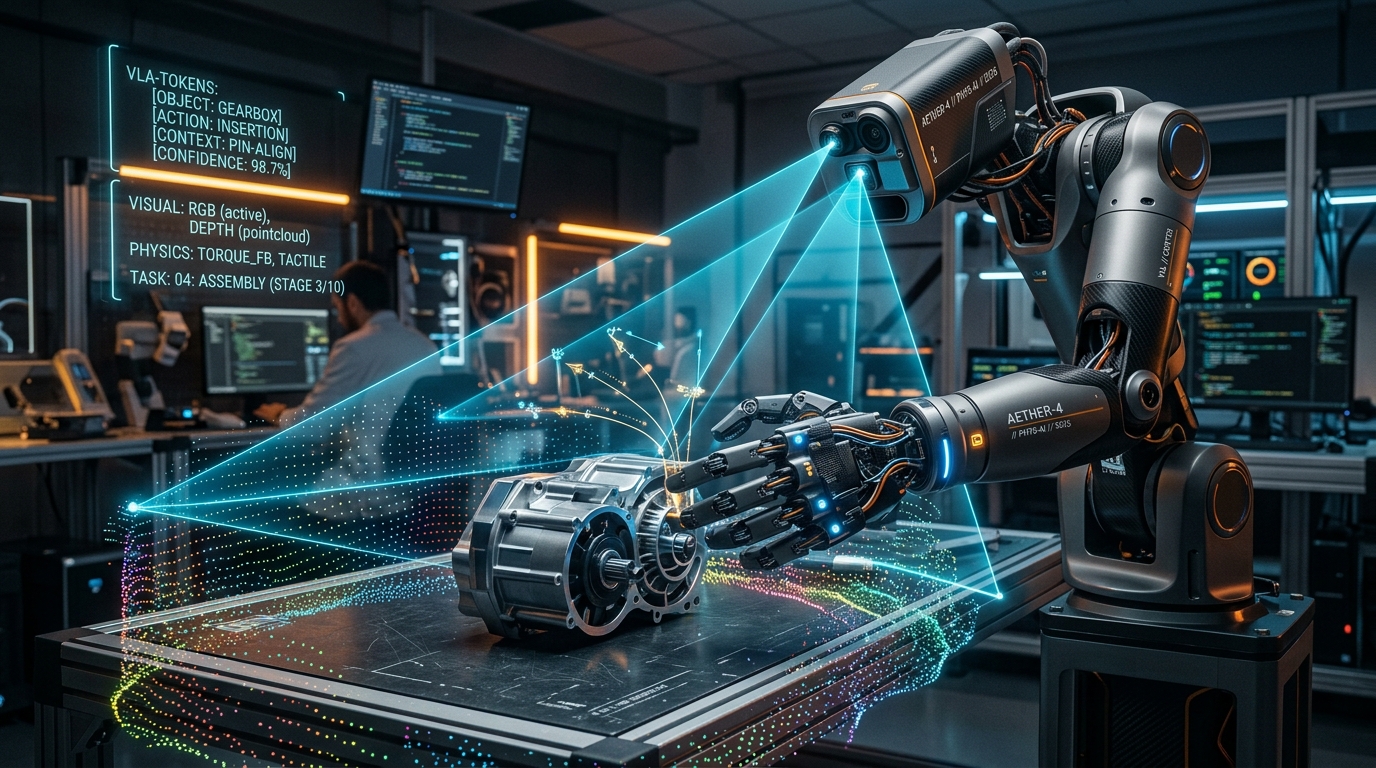
Think of a VLA model as a ‘brain’ that perceives the world as a stream of tokens. Just as an LLM predicts the next word in a sentence, a VLA model predicts the next ‘action token’ for a robot. The visual encoder (like a Vision Transformer) processes camera feeds into embeddings, while the language encoder processes natural language instructions (e.g., ‘put the red cup in the box’). The transformer backbone fuses these inputs, outputting continuous control parameters—such as end-effector 6-DOF poses or joint torques—as a sequence of tokens.
Architectural Breakdown & Algorithmic Mechanics
Modern frontier architectures like Google DeepMind’s RT-2 and OpenVLA utilize a pre-trained Vision-Language Model (VLM) backbone fine-tuned on robotic datasets. The key is action chunking: rather than predicting a single pose, the model predicts a sequence of future actions to ensure temporal consistency at 50Hz inference speeds. For a deep dive into the underlying compute requirements, see our guide on Test-Time Compute & Reasoning Models. These models often employ a discrete action space, mapping continuous values into a finite vocabulary of tokens, similar to how AI Coding Assistants predict code tokens.
Real-World Applications & Industry Use Cases
VLA models are currently revolutionizing two primary sectors:
- Warehouse Logistics: Autonomous sorting and ‘pick-and-place’ tasks that previously required rigid programming are now handled by models that can ‘see’ and ‘understand’ novel objects.
- Precision Manufacturing: Robots equipped with tactile-fusion VLA models perform delicate assembly tasks, adjusting pressure and grip in real-time based on visual feedback.
Key Advantages, Current Limitations & Trade-offs
Advantages: Unprecedented zero-shot generalization to new objects and instructions. Limitations: High latency in large models can hinder real-time performance, and ‘hallucinations’ in physical space can lead to safety risks. Furthermore, domain adaptation from simulators like Isaac Sim to real-world hardware remains a significant hurdle, often requiring extensive, high-quality real-world fine-tuning.
Best Practices & Practical Implementation Tips
To implement VLA systems effectively, focus on:
- Data Diversity: Prioritize diverse, multi-environment training data to prevent overfitting.
- Action Chunking: Use temporal action chunking to mitigate the ‘jitter’ often found in single-step inference.
- Sim-to-Real: Employ Domain Randomization within your simulation environment to ensure the model learns invariant features that transfer to the physical world.
Summary & Future Outlook
As Physical AI matures, we expect to see VLA models move beyond simple manipulation toward complex, long-horizon reasoning. The integration of tactile sensors and proprioceptive feedback will be the next frontier, turning robots from simple executors into truly intelligent, embodied agents.
Frequently Asked Questions (FAQ)
What is an action token in VLA models?
Action tokens are a discretized representation of physical motion, such as gripper velocity or end-effector translation, allowing the transformer to treat physical control as a sequence prediction task.
How do VLA models handle high-frequency control?
Most VLA models use action chunking, where the model outputs a sequence of future actions in a single forward pass, reducing the frequency of required inference calls and ensuring smooth motion.
Why is sim-to-real adaptation still a challenge?
Sim-to-real is difficult because of the ‘reality gap’—simulators often fail to capture complex physics like friction, soft-body deformation, and sensor noise, which the VLA model must compensate for during deployment.
Have thoughts on Vision-Language-Action (VLA) Models: How Physical AI Is Transforming Robotics in 2026?
Share your experiences, ask questions, or discuss prompt strategies with fellow creators in our AI Community Forum.