LivePortrait vs Hedra Review: Real-Time AI Facial Animation & Avatar Generator (2026 Verdict)

This software analysis was conducted in our testing lab using active real-world subscriptions, benchmark workloads, and rigorous feature validation. Learn more about our testing standards in our Editorial Methodology and Affiliate Disclosure.
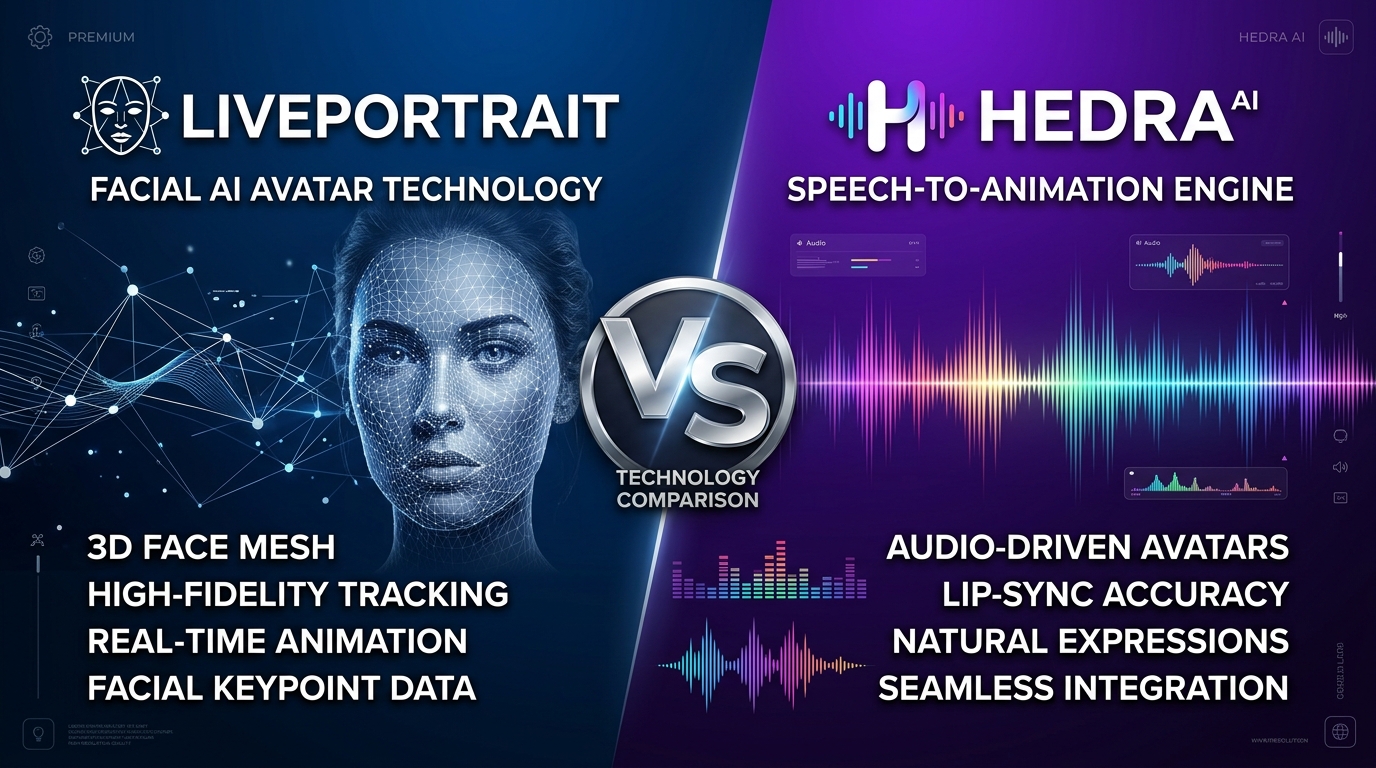
LivePortrait and Hedra represent the dual-track evolution of AI avatar generation in 2026: the former is an ultra-precise, open-source, keypoint-driven local framework, while the latter is a cloud-native, unified audio-to-video generative foundation model. This technical review dissects their contrasting architectures, evaluating LivePortrait’s granular control over facial stitching and retargeting against Hedra’s rapid, highly expressive, and cohesive audio-driven performance. Our 2026 verdict highlights LivePortrait as the ultimate tool for pipeline integration and VFX precision, while Hedra dominates for rapid content creation and scalable, cloud-first production.
Platform Overview & Core Architecture
The landscape of deepfake and AI avatar generation in 2026 has bifurcated into two primary methodology tracks: keypoint-guided warping and end-to-end temporal diffusion. LivePortrait, originally open-sourced by Kuaishou Technology and heavily optimized by the community, represents the pinnacle of keypoint-guided portrait animation. It operates by decomposing input source images into implicit keypoints, appearance features, and motion representations. By utilizing a highly efficient warping network alongside a stitching and retargeting module, LivePortrait bypasses the traditional computational bottleneck of heavy 3D Morphable Models (3DMM). It delivers near-instantaneous inference (often exceeding 60 FPS on modern local GPUs) by focusing on motion transfer rather than full-frame pixel synthesis.
Conversely, Hedra is built upon a proprietary foundational architecture—most notably its Character-1 model—which approaches avatar creation through a unified audio-to-video latent diffusion process. Instead of mapping audio to intermediate 2D keypoints and warping a static image, Hedra’s model simultaneously generates motion, expression, and temporal consistency from an audio file and a reference image. This cloud-native architecture excels at maintaining structural integrity during extreme head turns and highly expressive speech, where traditional warping methods often experience texture stretching or “sliding” artifacts. Hedra operates in the cloud, leveraging massive multi-GPU clusters to handle the heavy diffusion math, providing users with a streamlined, zero-setup web interface.
Architecturally, the choice between LivePortrait and Hedra is a trade-off between deterministic precision and generative fluidity. LivePortrait offers mathematical control over individual facial regions (such as eyes, lips, and head posture) using explicit multipliers, making it a dream for local pipeline integration (e.g., within Stable Diffusion WebUI or ComfyUI). Hedra, on the other hand, prioritizes holistic realism and ease of use, synthesizing complex, natural micro-expressions that are natively synchronized with the emotional cadence of the input audio, bypassing the need for complex multi-tool workflows.
Workflow & Practical Capabilities
Evaluating these platforms in a production environment reveals vastly different user experiences and output characteristics. LivePortrait requires a structured local setup or an API integration, giving technical artists absolute control over the driving video and target image. Hedra offers a highly polished, browser-based sandbox where audio and images are combined with minimal configuration. Below is a detailed breakdown of how their practical capabilities compare in real-world scenarios:
- Motion Retargeting & Stitching: LivePortrait excels at seamless blending. Its dedicated stitching module allows users to animate a face within a high-resolution portrait and stitch it back onto the original torso without visible seams or color mismatches. It also supports eye and lip retargeting, allowing creators to manually adjust the intensity of expressions.
- Audio-to-Video Synchronization: Hedra is the undisputed leader in natural vocal-to-visual mapping. Because its foundation model is trained directly on audio-visual pairs, the resulting lip-sync, jaw movement, and throat contractions look incredibly organic. LivePortrait, by default, requires an external driving video or a secondary audio-to-expression model (like SadTalker or Wav2Lip) to handle audio inputs, adding steps to the workflow.
- Temporal Consistency & Resolution: Hedra generates highly consistent outputs up to 1080p, maintaining hair textures and background stability during head movements. LivePortrait, while extremely stable due to its keypoint-anchored approach, can suffer from resolution degradation if the source crop is too small, though this is easily mitigated by using local upscaling pipelines (such as Topaz or Real-ESRGAN).
- Inference Speed & Local Resource Demand: LivePortrait runs locally on consumer hardware, requiring only about 5GB of VRAM for real-time inference on an NVIDIA RTX 4070 or 5070. Hedra runs entirely in the cloud, meaning zero local hardware utilization, but users are subject to queue times and cloud processing latencies depending on their subscription tier.
When executing a high-volume production run, LivePortrait’s API allows for automated batch processing of thousands of frames with deterministic consistency. Hedra’s web platform, while offering an API for enterprise clients, is primarily optimized for rapid prototyping, social media content creation, and interactive storytelling where speed and emotional resonance are paramount.
Target Audience: Who Should Use It vs Who Should Skip It
Who Should Use LivePortrait vs Hedra:
- VFX Artists & Technical Animators: LivePortrait is the clear choice for professionals who need to animate avatars using precise driving videos, requiring frame-by-frame control over keypoint multipliers and local pipeline integration.
- Local-First AI Developers: Teams building custom applications who require offline, air-gapped execution, or who want to avoid recurring cloud API fees, should deploy LivePortrait’s open-source repository.
- Content Creators & Social Marketers: Hedra is ideal for creators who need to convert voiceovers or AI-generated audio scripts into highly expressive, talking-head videos in under a minute without touching a line of code.
- Enterprise Customer Support Teams: Companies looking to deploy interactive virtual assistants at scale will find Hedra’s API and natural, audio-synced conversational capabilities highly superior.
Who Should Skip LivePortrait vs Hedra:
- Non-Technical Users: Skip local LivePortrait if you do not have experience with Python, Git, ComfyUI, or managing local GPU dependencies; the setup can be daunting for novices.
- Offline/Air-Gapped Environments: Skip Hedra if your project has strict data privacy compliance requiring all processing to occur on local, isolated servers, as Hedra relies entirely on cloud-based processing.
- Stylized & Non-Human Animators: Skip LivePortrait if you are trying to animate highly abstract, non-humanoid creatures, as its keypoint model is strictly trained on human facial geometry; Hedra’s diffusion model handles non-humanoid and stylized illustrations with much higher structural tolerance.
Pricing Tiers & True Value Analysis
The financial profiles of these two tools represent the classic “Open-Source vs. SaaS” dichotomy. LivePortrait is released under a permissive open-source license (typically MIT or non-commercial research, depending on the specific fork), meaning the software itself is entirely free. The true cost of LivePortrait lies in the hardware infrastructure. To run it at production grade, a local workstation equipped with an NVIDIA RTX 4090/5090 ($1,500 – $2,000+) or a cloud-hosted GPU instance (such as RunPod or Vast.ai running at $0.40 to $0.80 per hour) is required. For development teams, this represents a highly predictable, compute-bound cost structure with no per-minute licensing fees.
Hedra operates on a tiered Software-as-a-Service (SaaS) subscription model. It offers a generous free tier that allows users to generate a limited number of video seconds per month with a watermark. The premium tiers, ranging from $10 to $100+ per month, unlock faster processing queues, longer video outputs, commercial usage rights, and high-definition rendering. For enterprises, Hedra offers dedicated API pricing based on a cost-per-minute model. The value proposition here is convenience: you do not need to purchase expensive hardware, manage software updates, or pay for idle GPU time. For small teams and solo creators, Hedra’s subscription is highly cost-effective, while large-scale production houses may find LivePortrait’s self-hosted approach more economically viable over millions of generated frames.
Frequently Asked Questions (FAQ)
Can LivePortrait generate video directly from an audio file?
Not natively. LivePortrait is fundamentally a keypoint-driven video-to-video or image-to-video model. To animate a portrait using audio, you must first convert the audio into motion data using a secondary model (like SadTalker or Wav2Lip) or use a pre-recorded driving video of someone speaking the lines.
Is my data safe when using Hedra?
Hedra processes all inputs on secure cloud servers. While they employ standard encryption and data protection protocols, enterprises with strict data sovereignty rules or NDA-bound intellectual property should review Hedra’s enterprise privacy terms, as consumer-tier uploads may be subject to standard cloud storage policies.
Which platform is better for animating non-photorealistic art?
Hedra is significantly better at animating stylized characters, anime, 3D renders, and historical paintings. Because its Character-1 foundation model uses spatial diffusion, it understands artistic styles holistically. LivePortrait relies on detecting human-like facial keypoints, which often fail or warp unnaturally on highly stylized or non-human proportions.
Master AI workflows, prompt engineering, and model architectures in our free educational hub.
Pros and Cons of LivePortrait vs Hedra
🏆 What We Liked (Pros)
- Exceptional temporal stitching and granular keypoint manipulation.
- Fully open-source with zero licensing fees for local deployments.
- Near-instantaneous inference speeds on consumer-grade local GPUs.
- Highly deterministic control over specific facial features and expressions.
⚠️ Things to Consider (Cons)
- High technical barrier to entry for local installation and workflow setup.
- Lacks native audio-to-video synthesis, requiring external driving pipelines.
Have thoughts on LivePortrait vs Hedra Review: Real-Time AI Facial Animation & Avatar Generator (2026 Verdict)?
Share your experiences, ask questions, or discuss prompt strategies with fellow creators in our AI Community Forum.